
- (5.0 स्टार)
एआई और मशीन लर्निंग इंजीनियर
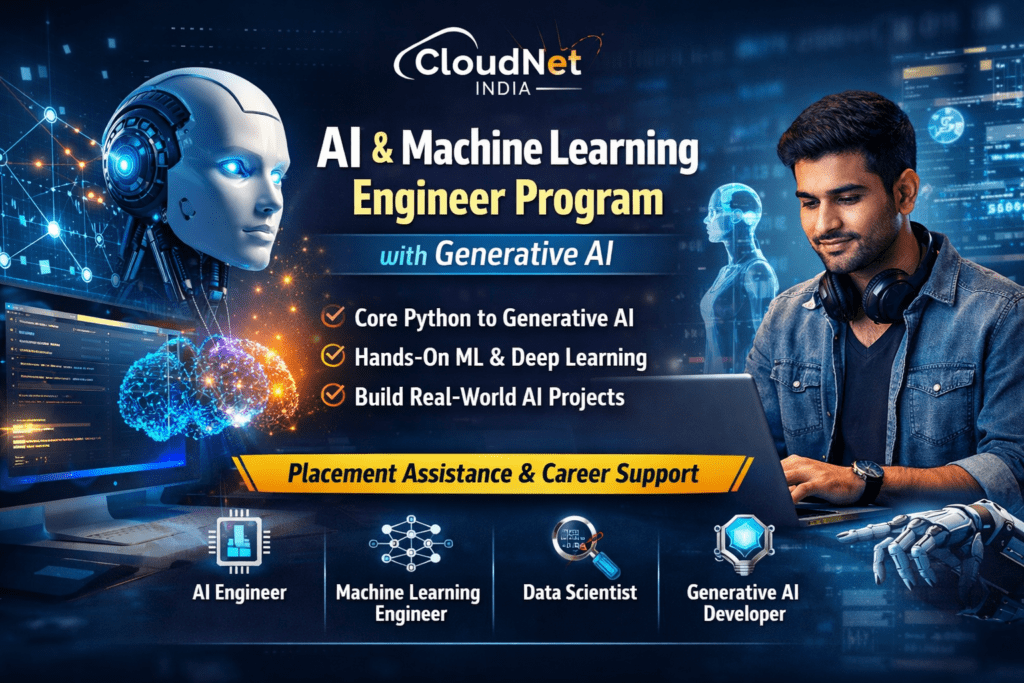
Professional Diploma Program AI & Machine Learning Engineer with Gen AI
We offer instructor-led online live virtual training and physical classroom training delivered by certified trainers and experienced industry professionals
- 25% तक की छूट पाएं
AI & Machine Learning Engineer from CloudNet India, Kolkata
एआई और मशीन लर्निंग इंजीनियर
With Generative AI | Placement Assistance by CloudNet India
TheAI & Machine Learning Engineer Program with Generative AI by CloudNet India is a comprehensive, job-oriented training program designed for students and working professionals who aspire to build a career in Artificial Intelligence and Machine Learning. This full-stack AI program guides learners from Core Python fundamentals to advanced Machine Learning, Deep Learning, and Generative AI applications, with a strong emphasis on hands-on practice, real-world projects, and industry-ready skills.
यह कोर्स कौन कर सकता है
This program is suitable for:
Students (Graduate / Final-year students) aspiring to enter the AI & ML domain
Working professionals looking to upskill or transition into AI roles
IT professionals, developers, analysts, and engineers
Freshers with basic computer knowledge and interest in AI & data-driven technologies
No prior AI experience is required; the course starts from fundamentals.
What You Will Learn (Aligned With Global Certifications)
The program follows a structured learning path:
Core Python Programming
Build strong programming logic, data structures, and problem-solving skills required for AI and ML roles.Python for AI & Machine Learning
Learn data analysis, visualization, and preprocessing using industry-standard Python libraries.Machine Learning
Understand supervised and unsupervised learning, model building, evaluation, and optimization with real-world use cases.Deep Learning
Design and train neural networks for image recognition, NLP, and time-series applications using TensorFlow and PyTorch.- Generative AI
Work with Transformers, LLMs, GANs, VAEs, and Diffusion Models, including prompt engineering, fine-tuning, and AI automation using tools like ChatGPT and Stable Diffusion.
Why To Enrol for CloudNet India, AI & Machine Learning Training Institute in Kolkata?
Hands-On Training & Real-World Projects
Learners gain practical exposure through:
Live instructor-led training (online & classroom)
Hands-on labs and real-world AI projects
Case studies aligned with industry use cases
End-to-end AI model development and deployment
Career Outcomes & Job Roles
After completing this program, learners can apply for roles such as:
AI Engineer
मशीन लर्निंग इंजीनियर
Data Scientist
NLP Engineer
Generative AI Developer
Placement Support by CloudNet India
CloudNet India provides placement assistance to help learners prepare for job opportunities through:
Resume & profile building support
Interview preparation and mock interviews
Career guidance and mentorship
हायरिंग पार्टनर्स के साथ जॉब रेफरल और इंटरव्यू के अवसर(subject to eligibility and performance)
क्लाउडनेट इंडिया को क्यों चुनें
Industry-expert instructors
Job-oriented curriculum aligned with current AI market demand
Practical, project-based learning approach
Classroom & online training options
Trusted IT training institute in India
मुख्य विशेषताएं
आपको 100% नौकरी का आश्वासन और आजीवन ई-प्लेसमेंट सहायता मिलेगी
विश्व स्तर पर प्रमाणित प्रशिक्षकों द्वारा कक्षाएं ली गईं
आपको 3 साल का समर्पित प्लेसमेंट सहायता मिलेगी
पाठ्यक्रम विश्व स्तर पर मान्यता प्राप्त और मान्यता प्राप्त हैं
पाठ्यक्रम का प्रकार:
Professional Diploma Program
लाइव वर्चुअल क्लासरूम:
60,000/-
75,000/-
नियमित क्लासरूम:
60,000/-
75,000/-
- अवधि:
12 महीने
- नामांकित:
67 Learners
- पात्रता:
10+2 / Any Graduate / BCA B.Tech BSc IT
- 5 स्टार:
47 Reviews
Full Syllabus - AI & Machine Learning Engineer with Gen AI
Module 1: Introduction to Python
- Introduction to programming languages
- Why Python?
- Python use cases and career scope
- Installing Python and IDE setup
- Writing and running Python programs
Module 2: Python Basics
- Variables and data types
- Input and output operations
- Operators and expressions
- Keywords and identifiers
- Type conversion
Module 3: Control Flow Statements
- Conditional statements (if, elif, else)
- Looping statements (for, while)
- Break, continue, and pass
- Nested loops
Module 4: Data Structures in Python
- Strings and string operations
- Lists and list methods
- Tuples and tuple operations
- Sets and set methods
- Dictionaries and dictionary operations
Module 5: Functions & Modules
- Defining and calling functions
- Function arguments and return values
- Lambda functions
- Built-in functions
- Creating and importing modules
- Packages
Module 6: Object-Oriented Programming (OOP)
- Classes and objects
- Constructors
- Instance and class variables
- Inheritance
- Polymorphism
- Encapsulation
- Abstraction
Module 7: Exception Handling
- Types of errors
- Try, except, else, finally
- Custom exceptions
- Best practices for error handling
Module 8: File Handling
- Reading and writing files
- File modes
- Working with CSV and text files
- File handling use cases
Module 9: Python Libraries & Utilities
- Math and random modules
- Date and time module
- OS and sys modules
- Regular expressions (regex)
Module 10: Python for Automation (Basics)
- Automating simple tasks
- Working with scripts
- Introduction to automation use cases
Module 11: Mini Project
- Problem statement discussion
- Logic building
- Python-based mini project
- Code review and optimization
Module 12: Interview & Placement Preparation
- Python interview questions
- Coding practice sessions
- Resume preparation
- Mock interviews
- Career guidance
Module 1: Python Ecosystem for AI & ML
- Python environment setup for AI development
- Virtual environments (venv, Conda)
- Jupyter Notebook & Google Colab for ML workflows
- Writing efficient, reusable Python code for ML projects
Module 2: Data Handling & Numerical Computing
- NumPy arrays, broadcasting, vectorization
- Linear algebra basics for ML (matrices, vectors)
- Random number generation & sampling
- Performance optimization using NumPy
Module 3: Data Analysis & Manipulation
- Pandas Series & DataFrames
- Data cleaning & preprocessing techniques
- Handling missing values & outliers
- Feature selection & transformation
- Time-series data handling
Module 4: Data Visualization for ML
- Data visualization using Matplotlib & Seaborn
- Statistical plots for data understanding
- Visualizing distributions, correlations & trends
- Visualization for model insights
Module 5: Statistics & Probability for Machine Learning
- Descriptive statistics
- Probability distributions
- Sampling techniques
- Hypothesis testing concepts
- Correlation & covariance
Module 6: Feature Engineering & Data Preparation
- Encoding categorical variables
- Feature scaling & normalization
- Dimensionality reduction concepts
- Data pipelines for ML workflows
Module 7: Python for Machine Learning Workflows
- Introduction to Scikit-learn
- Building ML pipelines
- Train-test split & cross-validation
- Model evaluation metrics
- Saving & loading models
Module 8: Python for Deep Learning Foundations
- Introduction to TensorFlow & PyTorch
- Tensors and computational graphs
- Data loaders & batching
- Training loops & optimization basics
Module 9: Python for Generative AI & LLMs
- Working with APIs (OpenAI / Hugging Face)
- Prompt engineering using Python
- Text generation & embeddings
- Image generation workflows
- Tokenization & vector databases basics
Module 10: Automation & AI Pipelines
- Automating ML workflows using Python
- Model inference pipelines
- Working with JSON, REST APIs
- Logging & monitoring basics
Module 11: Mini Projects (Hands-On)
- Data analysis & visualization project
- ML preprocessing pipeline project
- LLM-based text generation application
- Generative AI automation script
Module 1: Introduction to Machine Learning
- Definition and types of ML: Supervised, Unsupervised, Semi-supervised, Reinforcement Learning
- Role of ML in AI and Generative AI
- ML workflow: Data → Features → Model → Evaluation → Deployment
- Applications of ML across industries (Healthcare, Finance, NLP, Vision)
Module 2: Supervised Learning
- Regression Algorithms
- Linear Regression, Polynomial Regression
- Regularization: Ridge, Lasso, ElasticNet
- Evaluation metrics: MSE, RMSE, R², MAE
- Classification Algorithms
- Logistic Regression, K-Nearest Neighbors (KNN)
- Decision Trees, Random Forests, Gradient Boosting (XGBoost, LightGBM)
- Support Vector Machines (SVM)
- Evaluation metrics: Accuracy, Precision, Recall, F1-score, ROC-AUC
- Practical Hands-On
- Predicting housing prices (regression)
- Classifying emails as spam/non-spam (classification)
Module 3: Unsupervised Learning
- Clustering Techniques
- K-Means, Hierarchical Clustering, DBSCAN
- Silhouette score & elbow method
- Dimensionality Reduction
- Principal Component Analysis (PCA)
- t-SNE, UMAP for visualization
- Anomaly Detection
- Isolation Forest, One-Class SVM
- Isolation Forest, One-Class SVM
- Hands-On Projects
- Customer segmentation using clustering
- Fraud detection using anomaly detection
Module 4: Feature Engineering & Data Preprocessing
- Handling missing data and outliers
- Encoding categorical variables
- Feature scaling: Standardization, Normalization
- Feature selection techniques
- Creating ML pipelines for repeatable workflows
Module 5: Model Evaluation & Optimization
- Train-Test split, K-Fold Cross Validation
- Hyperparameter tuning: Grid Search, Random Search
- Regularization techniques to prevent overfitting
- Bias-Variance tradeoff and model selection
- Model interpretation with SHAP and LIME
Module 6: Ensemble Learning
- Bagging & Boosting techniques
- Random Forest, AdaBoost, Gradient Boosting
- XGBoost, LightGBM, CatBoost practical applications
- Voting and stacking ensemble methods
Module 7: Introduction to Neural Networks
- Perceptron and multilayer neural networks
- Activation functions: Sigmoid, ReLU, Softmax
- Forward propagation and backpropagation
- Training neural networks using TensorFlow & PyTorch
Module 8: Advanced Machine Learning Techniques
- Support Vector Machines (SVM) in-depth
- Kernel methods
- Time-series forecasting using ARIMA & LSTM
- Natural Language Processing (NLP) basics for AI
- Reinforcement learning overview
Module 9: Machine Learning for Generative AI
- Role of ML in Generative AI
- Dimensionality reduction for generative models
- Feature representation for LLMs and GANs
- Preparing datasets for text, image, and audio generation
- Introduction to prompt engineering and embeddings
Module 1: Introduction to Deep Learning
- What is Deep Learning and its importance in AI
- Difference between ML and DL
- Applications of Deep Learning: Computer Vision, NLP, Speech Recognition, Generative AI
- Overview of Deep Learning frameworks: TensorFlow & PyTorch
- GPU vs CPU for training
Module 2: Neural Network Fundamentals
- Perceptron and Multilayer Perceptrons (MLP)
- Activation functions: Sigmoid, ReLU, Tanh, Softmax
- Forward propagation & backpropagation
- Loss functions: Mean Squared Error, Cross-Entropy Loss
- Gradient descent and optimization basics
Module 3: Deep Learning Model Training
- Data preparation for Deep Learning
- Batch training, mini-batch gradient descent
- Learning rate, momentum, and optimizers (SGD, Adam, RMSProp)
- Overfitting and regularization: Dropout, L1/L2 Regularization
- Early stopping and checkpointing
Module 4: Convolutional Neural Networks (CNN)
- CNN architecture and concepts: Convolution, Pooling, Flattening
- Building CNNs for image classification
- Transfer learning: Pretrained models (VGG, ResNet, Inception)
- Data augmentation and image preprocessing
- Hands-on project: Image classification with CIFAR-10 / MNIST
Module 5: Recurrent Neural Networks (RNN)
- Sequence data and time-series basics
- RNN architecture and limitations
- LSTM (Long Short-Term Memory) and GRU (Gated Recurrent Unit) networks
- Applications in NLP, forecasting, and sequential prediction
- Hands-on project: Text sentiment analysis or stock price prediction
Module 6: Advanced Deep Learning Architectures
- Autoencoders for dimensionality reduction & anomaly detection
- Variational Autoencoders (VAE) for generative tasks
- Generative Adversarial Networks (GANs) basics
- Attention mechanism and introduction to Transformers
Module 7: Deep Learning for NLP
- Word embeddings: Word2Vec, GloVe, FastText
- Sequence-to-sequence models
- Transformer architecture: Attention, Encoder-Decoder
- Large Language Models (LLMs) overview
- Hands-on project: Text generation / summarization
Module 8: Deep Learning for Generative AI
- CNNs & GANs for image generation
- VAEs for latent space modeling
- Diffusion models basics
- Prompt engineering with LLMs for generative tasks
- Hands-on project: AI-generated text, images, or music
Module 9: Model Evaluation & Deployment
- Evaluating deep learning models (accuracy, F1, BLEU, ROUGE)
- Model saving & loading (HDF5, PyTorch formats)
- Exporting models for production (ONNX, TensorFlow Serving)
- Basic introduction to MLops for Deep Learning
Module 10: Hands-On Projects
- CNN Project: Image classification or object detection
- RNN/LSTM Project: Time-series forecasting or NLP task
- GAN Project: Image or audio generation
- Autoencoder/VAE Project: Anomaly detection / generative modeling
Module 1: Introduction to Generative AI
- What is Generative AI and its industry significance
- Difference between traditional AI and generative models
- Applications of Generative AI in business, art, NLP, and multimodal tasks
- Overview of GANs, VAEs, Diffusion Models, Transformers, and LLMs
Module 2: Data Preparation for Generative AI
- Dataset types for generative modeling (images, text, audio, multimodal)
- Data cleaning, preprocessing, and augmentation
- Feature representation and embeddings
- Tokenization for text, pixel normalization for images, and spectrograms for audio
- Handling large-scale datasets efficiently
Module 3: Generative Adversarial Networks (GANs)
- GAN architecture: Generator vs Discriminator
- Loss functions and training strategy
- Types of GANs: DCGAN, Conditional GAN, StyleGAN
- Challenges in training GANs (mode collapse, instability)
- Hands-on project: Image generation using DCGAN
Module 4: Variational Autoencoders (VAEs)
- Concept of latent space representation
- Encoder-Decoder architecture
- Sampling from latent space for generation
- Applications: Image synthesis, anomaly detection
- Hands-on project: Generating handwritten digits with VAE
Module 5: Diffusion Models
- Introduction to diffusion-based generative modeling
- Forward and reverse diffusion process
- Applications in image synthesis and enhancement
- Hands-on project: Image generation using diffusion model frameworks
Module 6: Transformers and Large Language Models (LLMs)
- Attention mechanism and Transformer architecture
- Encoder, Decoder, and Encoder-Decoder models
- Pretrained LLMs (GPT, BERT, LLaMA) for text generation
- Fine-tuning LLMs for domain-specific tasks
- Hands-on project: Chatbot or text summarization using Hugging Face Transformers
Module 7: Prompt Engineering & LLM Applications
- Fundamentals of prompt engineering
- Optimizing LLM outputs with few-shot and zero-shot learning
- Fine-tuning strategies: LoRA, PEFT
- Use cases: AI chatbots, text completion, code generation
- Hands-on project: Custom domain-specific LLM application
Module 8: Generative AI for Images & Multimedia
- Image generation using GANs, VAEs, and diffusion models
- Text-to-image generation (Stable Diffusion, DALL·E)
- AI for video and audio generation
- Multimodal AI concepts: Combining text, images, and audio
- Hands-on project: Text-to-image generation with Stable Diffusion
Module 9: Evaluation & Optimization of Generative Models
- Evaluation metrics for generative models: FID, IS, BLEU, ROUGE
- Model fine-tuning and hyperparameter optimization
- Reducing bias and ethical considerations in generative outputs
- Responsible AI practices for generative systems
Module 10: Deployment of Generative AI Models
- Exporting models for production (ONNX, TorchScript, TensorFlow SavedModel)
- Integration into web & mobile applications
- APIs and cloud deployment (AWS, Azure, GCP)
- Monitoring generative AI outputs in production
Module 11: Hands-On Projects
- GAN Project: Generating realistic images or art
- VAE Project: Latent space exploration for image synthesis
- Diffusion Model Project: High-quality text-to-image generation
- LLM Project: AI chatbot, summarization, or domain-specific assistant
- Multimodal AI Project: Combining text and image generation
हमें एक संदेश भेजें