
- (5.0 Star)
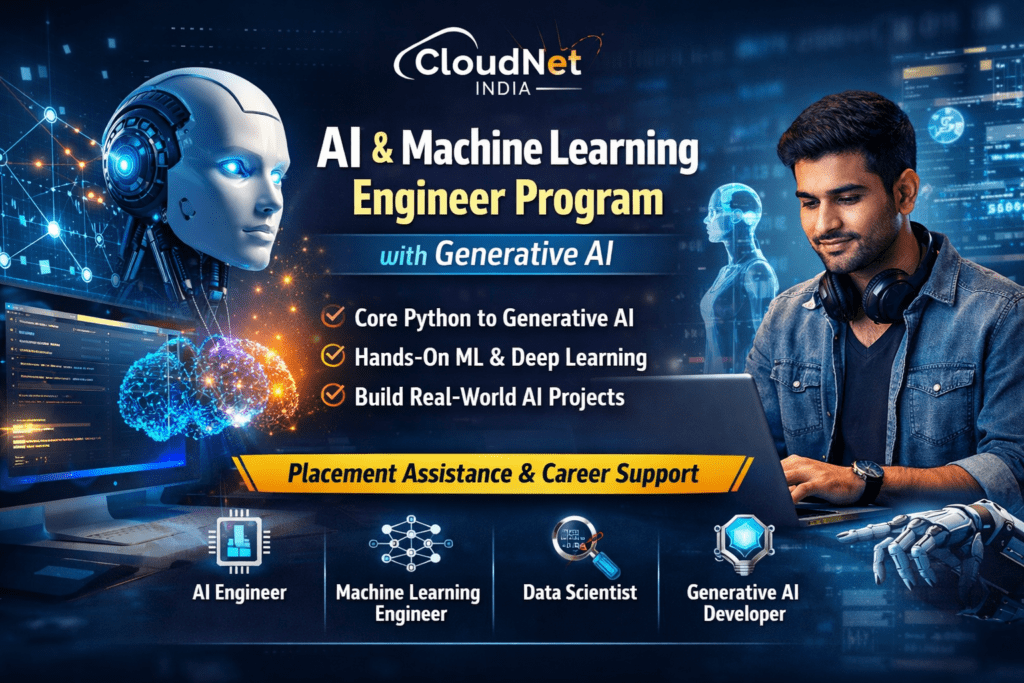
AI & Machine Learning Engineer
Professional Diploma Program AI & Machine Learning Engineer with Gen AI
We offer instructor-led online live virtual training and physical classroom training delivered by certified trainers and experienced industry professionals
- Get Up to 25% discount
AI & Machine Learning Engineer from CloudNet India, Kolkata
AI & Machine Learning Engineer
With Generative AI | Placement Assistance by CloudNet India
The AI & Machine Learning Engineer Program with Generative AI by CloudNet India is a comprehensive, job-oriented training program designed for students and working professionals who aspire to build a career in Artificial Intelligence and Machine Learning. This full-stack AI program guides learners from Core Python fundamentals to advanced Machine Learning, Deep Learning, and Generative AI applications, with a strong emphasis on hands-on practice, real-world projects, and industry-ready skills.
Who Can Join This Course
This program is suitable for:
Students (Graduate / Final-year students) aspiring to enter the AI & ML domain
Working professionals looking to upskill or transition into AI roles
IT professionals, developers, analysts, and engineers
Freshers with basic computer knowledge and interest in AI & data-driven technologies
No prior AI experience is required; the course starts from fundamentals.
What You Will Learn (Aligned With Global Certifications)
The program follows a structured learning path:
Core Python Programming
Build strong programming logic, data structures, and problem-solving skills required for AI and ML roles.Python for AI & Machine Learning
Learn data analysis, visualization, and preprocessing using industry-standard Python libraries.Machine Learning
Understand supervised and unsupervised learning, model building, evaluation, and optimization with real-world use cases.Deep Learning
Design and train neural networks for image recognition, NLP, and time-series applications using TensorFlow and PyTorch.- Generative AI
Work with Transformers, LLMs, GANs, VAEs, and Diffusion Models, including prompt engineering, fine-tuning, and AI automation using tools like ChatGPT and Stable Diffusion.
Why To Enrol for CloudNet India, AI & Machine Learning Training Institute in Kolkata?
Hands-On Training & Real-World Projects
Learners gain practical exposure through:
Live instructor-led training (online & classroom)
Hands-on labs and real-world AI projects
Case studies aligned with industry use cases
End-to-end AI model development and deployment
Career Outcomes & Job Roles
After completing this program, learners can apply for roles such as:
AI Engineer
Machine Learning Engineer
Data Scientist
NLP Engineer
Generative AI Developer
Placement Support by CloudNet India
CloudNet India provides placement assistance to help learners prepare for job opportunities through:
Resume & profile building support
Interview preparation and mock interviews
Career guidance and mentorship
Job referrals and interview opportunities with hiring partners (subject to eligibility and performance)
Why Choose CloudNet India
Industry-expert instructors
Job-oriented curriculum aligned with current AI market demand
Practical, project-based learning approach
Classroom & online training options
Trusted IT training institute in India
Key Features
You will get 100% job Assurance and life time e-placement support
classed taken by globally certified trainers
You will get 3 year Dedicated placement support
Courses are globally recognized & accredited
Course Type:
Professional Diploma Program
Live virtual classroom:
60,000/-
75,000/-
Regular classroom:
60,000/-
75,000/-
- Duration:
12 Months
- Enrolled:
67 Learners
- Eligibility:
10+2 / Any Graduate / BCA B.Tech BSc IT
- 5 Star:
47 Reviews
Full Syllabus - AI & Machine Learning Engineer with Gen AI
Module 1: Introduction to Python
- Introduction to programming languages
- Why Python?
- Python use cases and career scope
- Installing Python and IDE setup
- Writing and running Python programs
Module 2: Python Basics
- Variables and data types
- Input and output operations
- Operators and expressions
- Keywords and identifiers
- Type conversion
Module 3: Control Flow Statements
- Conditional statements (if, elif, else)
- Looping statements (for, while)
- Break, continue, and pass
- Nested loops
Module 4: Data Structures in Python
- Strings and string operations
- Lists and list methods
- Tuples and tuple operations
- Sets and set methods
- Dictionaries and dictionary operations
Module 5: Functions & Modules
- Defining and calling functions
- Function arguments and return values
- Lambda functions
- Built-in functions
- Creating and importing modules
- Packages
Module 6: Object-Oriented Programming (OOP)
- Classes and objects
- Constructors
- Instance and class variables
- Inheritance
- Polymorphism
- Encapsulation
- Abstraction
Module 7: Exception Handling
- Types of errors
- Try, except, else, finally
- Custom exceptions
- Best practices for error handling
Module 8: File Handling
- Reading and writing files
- File modes
- Working with CSV and text files
- File handling use cases
Module 9: Python Libraries & Utilities
- Math and random modules
- Date and time module
- OS and sys modules
- Regular expressions (regex)
Module 10: Python for Automation (Basics)
- Automating simple tasks
- Working with scripts
- Introduction to automation use cases
Module 11: Mini Project
- Problem statement discussion
- Logic building
- Python-based mini project
- Code review and optimization
Module 12: Interview & Placement Preparation
- Python interview questions
- Coding practice sessions
- Resume preparation
- Mock interviews
- Career guidance
Module 1: Python Ecosystem for AI & ML
- Python environment setup for AI development
- Virtual environments (venv, Conda)
- Jupyter Notebook & Google Colab for ML workflows
- Writing efficient, reusable Python code for ML projects
Module 2: Data Handling & Numerical Computing
- NumPy arrays, broadcasting, vectorization
- Linear algebra basics for ML (matrices, vectors)
- Random number generation & sampling
- Performance optimization using NumPy
Module 3: Data Analysis & Manipulation
- Pandas Series & DataFrames
- Data cleaning & preprocessing techniques
- Handling missing values & outliers
- Feature selection & transformation
- Time-series data handling
Module 4: Data Visualization for ML
- Data visualization using Matplotlib & Seaborn
- Statistical plots for data understanding
- Visualizing distributions, correlations & trends
- Visualization for model insights
Module 5: Statistics & Probability for Machine Learning
- Descriptive statistics
- Probability distributions
- Sampling techniques
- Hypothesis testing concepts
- Correlation & covariance
Module 6: Feature Engineering & Data Preparation
- Encoding categorical variables
- Feature scaling & normalization
- Dimensionality reduction concepts
- Data pipelines for ML workflows
Module 7: Python for Machine Learning Workflows
- Introduction to Scikit-learn
- Building ML pipelines
- Train-test split & cross-validation
- Model evaluation metrics
- Saving & loading models
Module 8: Python for Deep Learning Foundations
- Introduction to TensorFlow & PyTorch
- Tensors and computational graphs
- Data loaders & batching
- Training loops & optimization basics
Module 9: Python for Generative AI & LLMs
- Working with APIs (OpenAI / Hugging Face)
- Prompt engineering using Python
- Text generation & embeddings
- Image generation workflows
- Tokenization & vector databases basics
Module 10: Automation & AI Pipelines
- Automating ML workflows using Python
- Model inference pipelines
- Working with JSON, REST APIs
- Logging & monitoring basics
Module 11: Mini Projects (Hands-On)
- Data analysis & visualization project
- ML preprocessing pipeline project
- LLM-based text generation application
- Generative AI automation script
Module 1: Introduction to Machine Learning
- Definition and types of ML: Supervised, Unsupervised, Semi-supervised, Reinforcement Learning
- Role of ML in AI and Generative AI
- ML workflow: Data → Features → Model → Evaluation → Deployment
- Applications of ML across industries (Healthcare, Finance, NLP, Vision)
Module 2: Supervised Learning
- Regression Algorithms
- Linear Regression, Polynomial Regression
- Regularization: Ridge, Lasso, ElasticNet
- Evaluation metrics: MSE, RMSE, R², MAE
- Classification Algorithms
- Logistic Regression, K-Nearest Neighbors (KNN)
- Decision Trees, Random Forests, Gradient Boosting (XGBoost, LightGBM)
- Support Vector Machines (SVM)
- Evaluation metrics: Accuracy, Precision, Recall, F1-score, ROC-AUC
- Practical Hands-On
- Predicting housing prices (regression)
- Classifying emails as spam/non-spam (classification)
Module 3: Unsupervised Learning
- Clustering Techniques
- K-Means, Hierarchical Clustering, DBSCAN
- Silhouette score & elbow method
- Dimensionality Reduction
- Principal Component Analysis (PCA)
- t-SNE, UMAP for visualization
- Anomaly Detection
- Isolation Forest, One-Class SVM
- Isolation Forest, One-Class SVM
- Hands-On Projects
- Customer segmentation using clustering
- Fraud detection using anomaly detection
Module 4: Feature Engineering & Data Preprocessing
- Handling missing data and outliers
- Encoding categorical variables
- Feature scaling: Standardization, Normalization
- Feature selection techniques
- Creating ML pipelines for repeatable workflows
Module 5: Model Evaluation & Optimization
- Train-Test split, K-Fold Cross Validation
- Hyperparameter tuning: Grid Search, Random Search
- Regularization techniques to prevent overfitting
- Bias-Variance tradeoff and model selection
- Model interpretation with SHAP and LIME
Module 6: Ensemble Learning
- Bagging & Boosting techniques
- Random Forest, AdaBoost, Gradient Boosting
- XGBoost, LightGBM, CatBoost practical applications
- Voting and stacking ensemble methods
Module 7: Introduction to Neural Networks
- Perceptron and multilayer neural networks
- Activation functions: Sigmoid, ReLU, Softmax
- Forward propagation and backpropagation
- Training neural networks using TensorFlow & PyTorch
Module 8: Advanced Machine Learning Techniques
- Support Vector Machines (SVM) in-depth
- Kernel methods
- Time-series forecasting using ARIMA & LSTM
- Natural Language Processing (NLP) basics for AI
- Reinforcement learning overview
Module 9: Machine Learning for Generative AI
- Role of ML in Generative AI
- Dimensionality reduction for generative models
- Feature representation for LLMs and GANs
- Preparing datasets for text, image, and audio generation
- Introduction to prompt engineering and embeddings
Module 1: Introduction to Deep Learning
- What is Deep Learning and its importance in AI
- Difference between ML and DL
- Applications of Deep Learning: Computer Vision, NLP, Speech Recognition, Generative AI
- Overview of Deep Learning frameworks: TensorFlow & PyTorch
- GPU vs CPU for training
Module 2: Neural Network Fundamentals
- Perceptron and Multilayer Perceptrons (MLP)
- Activation functions: Sigmoid, ReLU, Tanh, Softmax
- Forward propagation & backpropagation
- Loss functions: Mean Squared Error, Cross-Entropy Loss
- Gradient descent and optimization basics
Module 3: Deep Learning Model Training
- Data preparation for Deep Learning
- Batch training, mini-batch gradient descent
- Learning rate, momentum, and optimizers (SGD, Adam, RMSProp)
- Overfitting and regularization: Dropout, L1/L2 Regularization
- Early stopping and checkpointing
Module 4: Convolutional Neural Networks (CNN)
- CNN architecture and concepts: Convolution, Pooling, Flattening
- Building CNNs for image classification
- Transfer learning: Pretrained models (VGG, ResNet, Inception)
- Data augmentation and image preprocessing
- Hands-on project: Image classification with CIFAR-10 / MNIST
Module 5: Recurrent Neural Networks (RNN)
- Sequence data and time-series basics
- RNN architecture and limitations
- LSTM (Long Short-Term Memory) and GRU (Gated Recurrent Unit) networks
- Applications in NLP, forecasting, and sequential prediction
- Hands-on project: Text sentiment analysis or stock price prediction
Module 6: Advanced Deep Learning Architectures
- Autoencoders for dimensionality reduction & anomaly detection
- Variational Autoencoders (VAE) for generative tasks
- Generative Adversarial Networks (GANs) basics
- Attention mechanism and introduction to Transformers
Module 7: Deep Learning for NLP
- Word embeddings: Word2Vec, GloVe, FastText
- Sequence-to-sequence models
- Transformer architecture: Attention, Encoder-Decoder
- Large Language Models (LLMs) overview
- Hands-on project: Text generation / summarization
Module 8: Deep Learning for Generative AI
- CNNs & GANs for image generation
- VAEs for latent space modeling
- Diffusion models basics
- Prompt engineering with LLMs for generative tasks
- Hands-on project: AI-generated text, images, or music
Module 9: Model Evaluation & Deployment
- Evaluating deep learning models (accuracy, F1, BLEU, ROUGE)
- Model saving & loading (HDF5, PyTorch formats)
- Exporting models for production (ONNX, TensorFlow Serving)
- Basic introduction to MLops for Deep Learning
Module 10: Hands-On Projects
- CNN Project: Image classification or object detection
- RNN/LSTM Project: Time-series forecasting or NLP task
- GAN Project: Image or audio generation
- Autoencoder/VAE Project: Anomaly detection / generative modeling
Module 1: Introduction to Generative AI
- What is Generative AI and its industry significance
- Difference between traditional AI and generative models
- Applications of Generative AI in business, art, NLP, and multimodal tasks
- Overview of GANs, VAEs, Diffusion Models, Transformers, and LLMs
Module 2: Data Preparation for Generative AI
- Dataset types for generative modeling (images, text, audio, multimodal)
- Data cleaning, preprocessing, and augmentation
- Feature representation and embeddings
- Tokenization for text, pixel normalization for images, and spectrograms for audio
- Handling large-scale datasets efficiently
Module 3: Generative Adversarial Networks (GANs)
- GAN architecture: Generator vs Discriminator
- Loss functions and training strategy
- Types of GANs: DCGAN, Conditional GAN, StyleGAN
- Challenges in training GANs (mode collapse, instability)
- Hands-on project: Image generation using DCGAN
Module 4: Variational Autoencoders (VAEs)
- Concept of latent space representation
- Encoder-Decoder architecture
- Sampling from latent space for generation
- Applications: Image synthesis, anomaly detection
- Hands-on project: Generating handwritten digits with VAE
Module 5: Diffusion Models
- Introduction to diffusion-based generative modeling
- Forward and reverse diffusion process
- Applications in image synthesis and enhancement
- Hands-on project: Image generation using diffusion model frameworks
Module 6: Transformers and Large Language Models (LLMs)
- Attention mechanism and Transformer architecture
- Encoder, Decoder, and Encoder-Decoder models
- Pretrained LLMs (GPT, BERT, LLaMA) for text generation
- Fine-tuning LLMs for domain-specific tasks
- Hands-on project: Chatbot or text summarization using Hugging Face Transformers
Module 7: Prompt Engineering & LLM Applications
- Fundamentals of prompt engineering
- Optimizing LLM outputs with few-shot and zero-shot learning
- Fine-tuning strategies: LoRA, PEFT
- Use cases: AI chatbots, text completion, code generation
- Hands-on project: Custom domain-specific LLM application
Module 8: Generative AI for Images & Multimedia
- Image generation using GANs, VAEs, and diffusion models
- Text-to-image generation (Stable Diffusion, DALL·E)
- AI for video and audio generation
- Multimodal AI concepts: Combining text, images, and audio
- Hands-on project: Text-to-image generation with Stable Diffusion
Module 9: Evaluation & Optimization of Generative Models
- Evaluation metrics for generative models: FID, IS, BLEU, ROUGE
- Model fine-tuning and hyperparameter optimization
- Reducing bias and ethical considerations in generative outputs
- Responsible AI practices for generative systems
Module 10: Deployment of Generative AI Models
- Exporting models for production (ONNX, TorchScript, TensorFlow SavedModel)
- Integration into web & mobile applications
- APIs and cloud deployment (AWS, Azure, GCP)
- Monitoring generative AI outputs in production
Module 11: Hands-On Projects
- GAN Project: Generating realistic images or art
- VAE Project: Latent space exploration for image synthesis
- Diffusion Model Project: High-quality text-to-image generation
- LLM Project: AI chatbot, summarization, or domain-specific assistant
- Multimodal AI Project: Combining text and image generation
Sent Us a Message