
- (5.0 Star)
Machine Learning Engineer
Professional Certification in Machine Learning Engineer
We offer instructor-led online live virtual training and physical classroom training delivered by certified trainers and experienced industry professionals
- Get Up to 25% discount
Spearhead Your Career in Machine Learning Engineer from CloudNet India, Kolkata
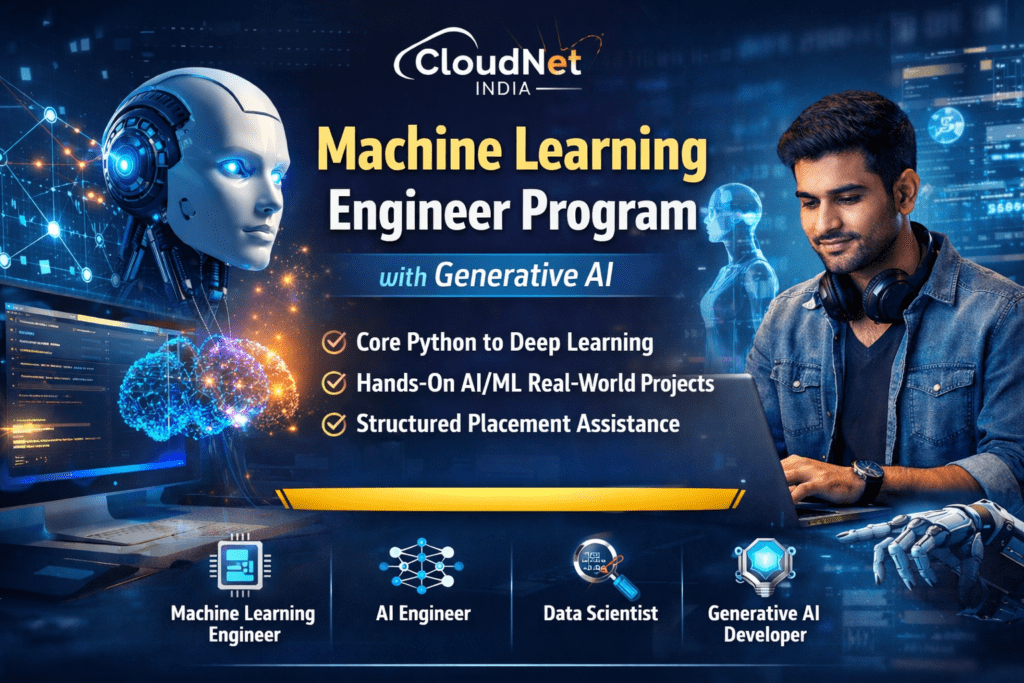
Machine Learning Engineer With Generative AI | Placement Assistance by CloudNet India
Machine Learning Engineer Program – CloudNet India, Kolkata
The Machine Learning Engineer Program by CloudNet India, Kolkata is a comprehensive, industry-focused training program designed for students and professionals who aspire to build a successful career in Artificial Intelligence and Machine Learning. This full-stack AI program takes learners from Core Python fundamentals to Python for Machine Learning & AI, Machine Learning, and Deep Learning, combining hands-on projects, practical applications, and industry-ready skills to prepare learners for real-world AI challenges.
Who Can Join This Program
This program is ideal for:
Students (Graduates / Final-Year Students) aspiring to enter the AI/ML domain
IT professionals, software developers, analysts, and engineers looking to upskill or transition into AI/ML roles
Freshers with basic computer knowledge and interest in AI and data-driven technologies
Professionals seeking careers in Machine Learning, Deep Learning, AI Development, NLP, or Generative AI
No prior AI or ML experience is required, as the course starts with Core Python fundamentals and gradually advances to Machine Learning and Deep Learning applications.
Certification Training Covered (Aligned With Global Certifications)
Technologies & Certification
Core Python
Python for Machine Learning & AI
Machine Learning
Deep Learning
Career Outcomes & Job Roles
After completing this program, learners can pursue roles such as:
Machine Learning Engineer
AI Engineer
Deep Learning Engineer
Data Scientist
NLP Engineer
Generative AI Developer
Placement Support by CloudNet India
CloudNet India provides structured placement assistance to help learners succeed in the AI job market:
Resume building and professional profile optimization
Mock interviews and technical preparation
Career mentoring and job search guidance
Eligible learners may receive job referrals and interview opportunities with hiring partners (subject to performance and readiness)
This ensures learners are not only trained in AI & ML technologies but are also prepared to secure real-world job opportunities with confidence.
Why Choose CloudNet India
Industry-expert instructors with real-world experience
Hands-on, job-oriented curriculum covering Python → Machine Learning → Deep Learning → Generative AI
Practical projects and portfolio development
Flexible online and classroom training options
Trusted IT training institute in Kolkata, India
Learning Outcomes
By the end of this program, learners will be able to:
Write efficient Python code and build AI/ML workflows
Design, train, and deploy Machine Learning models
Implement Deep Learning architectures for real-world AI problems
Work on Generative AI and NLP projects
Prepare for high-demand AI roles with placement support from CloudNet India
Key Features
You will get 100% job Assurance and life time e-placement support
classed taken by globally certified trainers
You will get 3 year Dedicated placement support
Courses are globally recognized & accredited
Course Type:
Certification Program
Live virtual classroom:
43,000/-
60,000/-
Regular classroom:
43,000/-
60,000/-
- Duration:
9 Months
- Enrolled:
49 Learners
- Eligibility:
10+2 / Any Graduate / BCA B.Tech BSc IT
- 5 Star:
17 Reviews
Module - I
Module 1: Introduction to Python
- Introduction to programming languages
- Why Python?
- Python use cases and career scope
- Installing Python and IDE setup
- Writing and running Python programs
Module 2: Python Basics
- Variables and data types
- Input and output operations
- Operators and expressions
- Keywords and identifiers
- Type conversion
Module 3: Control Flow Statements
- Conditional statements (if, elif, else)
- Looping statements (for, while)
- Break, continue, and pass
- Nested loops
Module 4: Data Structures in Python
- Strings and string operations
- Lists and list methods
- Tuples and tuple operations
- Sets and set methods
- Dictionaries and dictionary operations
Module 5: Functions & Modules
- Defining and calling functions
- Function arguments and return values
- Lambda functions
- Built-in functions
- Creating and importing modules
- Packages
Module 6: Object-Oriented Programming (OOP)
- Classes and objects
- Constructors
- Instance and class variables
- Inheritance
- Polymorphism
- Encapsulation
- Abstraction
Module 7: Exception Handling
- Types of errors
- Try, except, else, finally
- Custom exceptions
- Best practices for error handling
Module 8: File Handling
- Reading and writing files
- File modes
- Working with CSV and text files
- File handling use cases
Module 9: Python Libraries & Utilities
- Math and random modules
- Date and time module
- OS and sys modules
- Regular expressions (regex)
Module 10: Python for Automation (Basics)
- Automating simple tasks
- Working with scripts
- Introduction to automation use cases
Module 11: Mini Project
- Problem statement discussion
- Logic building
- Python-based mini project
- Code review and optimization
Module 12: Interview & Placement Preparation
- Python interview questions
- Coding practice sessions
- Resume preparation
- Mock interviews
- Career guidance
Module 1: Python Ecosystem for AI & ML
- Python environment setup for AI development
- Virtual environments (venv, Conda)
- Jupyter Notebook & Google Colab for ML workflows
- Writing efficient, reusable Python code for ML projects
Module 2: Data Handling & Numerical Computing
- NumPy arrays, broadcasting, vectorization
- Linear algebra basics for ML (matrices, vectors)
- Random number generation & sampling
- Performance optimization using NumPy
Module 3: Data Analysis & Manipulation
- Pandas Series & DataFrames
- Data cleaning & preprocessing techniques
- Handling missing values & outliers
- Feature selection & transformation
- Time-series data handling
Module 4: Data Visualization for ML
- Data visualization using Matplotlib & Seaborn
- Statistical plots for data understanding
- Visualizing distributions, correlations & trends
- Visualization for model insights
Module 5: Statistics & Probability for Machine Learning
- Descriptive statistics
- Probability distributions
- Sampling techniques
- Hypothesis testing concepts
- Correlation & covariance
Module 6: Feature Engineering & Data Preparation
- Encoding categorical variables
- Feature scaling & normalization
- Dimensionality reduction concepts
- Data pipelines for ML workflows
Module 7: Python for Machine Learning Workflows
- Introduction to Scikit-learn
- Building ML pipelines
- Train-test split & cross-validation
- Model evaluation metrics
- Saving & loading models
Module 8: Python for Deep Learning Foundations
- Introduction to TensorFlow & PyTorch
- Tensors and computational graphs
- Data loaders & batching
- Training loops & optimization basics
Module 9: Python for Generative AI & LLMs
- Working with APIs (OpenAI / Hugging Face)
- Prompt engineering using Python
- Text generation & embeddings
- Image generation workflows
- Tokenization & vector databases basics
Module 10: Automation & AI Pipelines
- Automating ML workflows using Python
- Model inference pipelines
- Working with JSON, REST APIs
- Logging & monitoring basics
Module 11: Mini Projects (Hands-On)
- Data analysis & visualization project
- ML preprocessing pipeline project
- LLM-based text generation application
- Generative AI automation script
Module 1: Introduction to Machine Learning
- Definition and types of ML: Supervised, Unsupervised, Semi-supervised, Reinforcement Learning
- Role of ML in AI and Generative AI
- ML workflow: Data → Features → Model → Evaluation → Deployment
- Applications of ML across industries (Healthcare, Finance, NLP, Vision)
Module 2: Supervised Learning
- Regression Algorithms
- Linear Regression, Polynomial Regression
- Regularization: Ridge, Lasso, ElasticNet
- Evaluation metrics: MSE, RMSE, R², MAE
- Classification Algorithms
- Logistic Regression, K-Nearest Neighbors (KNN)
- Decision Trees, Random Forests, Gradient Boosting (XGBoost, LightGBM)
- Support Vector Machines (SVM)
- Evaluation metrics: Accuracy, Precision, Recall, F1-score, ROC-AUC
- Practical Hands-On
- Predicting housing prices (regression)
- Classifying emails as spam/non-spam (classification)
Module 3: Unsupervised Learning
- Clustering Techniques
- K-Means, Hierarchical Clustering, DBSCAN
- Silhouette score & elbow method
- Dimensionality Reduction
- Principal Component Analysis (PCA)
- t-SNE, UMAP for visualization
- Anomaly Detection
- Isolation Forest, One-Class SVM
- Isolation Forest, One-Class SVM
- Hands-On Projects
- Customer segmentation using clustering
- Fraud detection using anomaly detection
Module 4: Feature Engineering & Data Preprocessing
- Handling missing data and outliers
- Encoding categorical variables
- Feature scaling: Standardization, Normalization
- Feature selection techniques
- Creating ML pipelines for repeatable workflows
Module 5: Model Evaluation & Optimization
- Train-Test split, K-Fold Cross Validation
- Hyperparameter tuning: Grid Search, Random Search
- Regularization techniques to prevent overfitting
- Bias-Variance tradeoff and model selection
- Model interpretation with SHAP and LIME
Module 6: Ensemble Learning
- Bagging & Boosting techniques
- Random Forest, AdaBoost, Gradient Boosting
- XGBoost, LightGBM, CatBoost practical applications
- Voting and stacking ensemble methods
Module 7: Introduction to Neural Networks
- Perceptron and multilayer neural networks
- Activation functions: Sigmoid, ReLU, Softmax
- Forward propagation and backpropagation
- Training neural networks using TensorFlow & PyTorch
Module 8: Advanced Machine Learning Techniques
- Support Vector Machines (SVM) in-depth
- Kernel methods
- Time-series forecasting using ARIMA & LSTM
- Natural Language Processing (NLP) basics for AI
- Reinforcement learning overview
Module 9: Machine Learning for Generative AI
- Role of ML in Generative AI
- Dimensionality reduction for generative models
- Feature representation for LLMs and GANs
- Preparing datasets for text, image, and audio generation
Module 1: Introduction to Deep Learning
- What is Deep Learning and its importance in AI
- Difference between ML and DL
- Applications of Deep Learning: Computer Vision, NLP, Speech Recognition, Generative AI
- Overview of Deep Learning frameworks: TensorFlow & PyTorch
- GPU vs CPU for training
Module 2: Neural Network Fundamentals
- Perceptron and Multilayer Perceptrons (MLP)
- Activation functions: Sigmoid, ReLU, Tanh, Softmax
- Forward propagation & backpropagation
- Loss functions: Mean Squared Error, Cross-Entropy Loss
- Gradient descent and optimization basics
Module 3: Deep Learning Model Training
- Data preparation for Deep Learning
- Batch training, mini-batch gradient descent
- Learning rate, momentum, and optimizers (SGD, Adam, RMSProp)
- Overfitting and regularization: Dropout, L1/L2 Regularization
- Early stopping and checkpointing
Module 4: Convolutional Neural Networks (CNN)
- CNN architecture and concepts: Convolution, Pooling, Flattening
- Building CNNs for image classification
- Transfer learning: Pretrained models (VGG, ResNet, Inception)
- Data augmentation and image preprocessing
- Hands-on project: Image classification with CIFAR-10 / MNIST
Module 5: Recurrent Neural Networks (RNN)
- Sequence data and time-series basics
- RNN architecture and limitations
- LSTM (Long Short-Term Memory) and GRU (Gated Recurrent Unit) networks
- Applications in NLP, forecasting, and sequential prediction
- Hands-on project: Text sentiment analysis or stock price prediction
Module 6: Advanced Deep Learning Architectures
- Autoencoders for dimensionality reduction & anomaly detection
- Variational Autoencoders (VAE) for generative tasks
- Generative Adversarial Networks (GANs) basics
- Attention mechanism and introduction to Transformers
Module 7: Deep Learning for NLP
- Word embeddings: Word2Vec, GloVe, FastText
- Sequence-to-sequence models
- Transformer architecture: Attention, Encoder-Decoder
- Large Language Models (LLMs) overview
- Hands-on project: Text generation / summarization
Module 8: Deep Learning for Generative AI
- CNNs & GANs for image generation
- VAEs for latent space modeling
- Diffusion models basics
- Prompt engineering with LLMs for generative tasks
- Hands-on project: AI-generated text, images, or music
Module 9: Model Evaluation & Deployment
- Evaluating deep learning models (accuracy, F1, BLEU, ROUGE)
- Model saving & loading (HDF5, PyTorch formats)
- Exporting models for production (ONNX, TensorFlow Serving)
- Basic introduction to MLops for Deep Learning
Module 10: Hands-On Projects
- CNN Project: Image classification or object detection
- RNN/LSTM Project: Time-series forecasting or NLP task
- GAN Project: Image or audio generation
- Autoencoder/VAE Project: Anomaly detection / generative modeling
Sent Us a Message